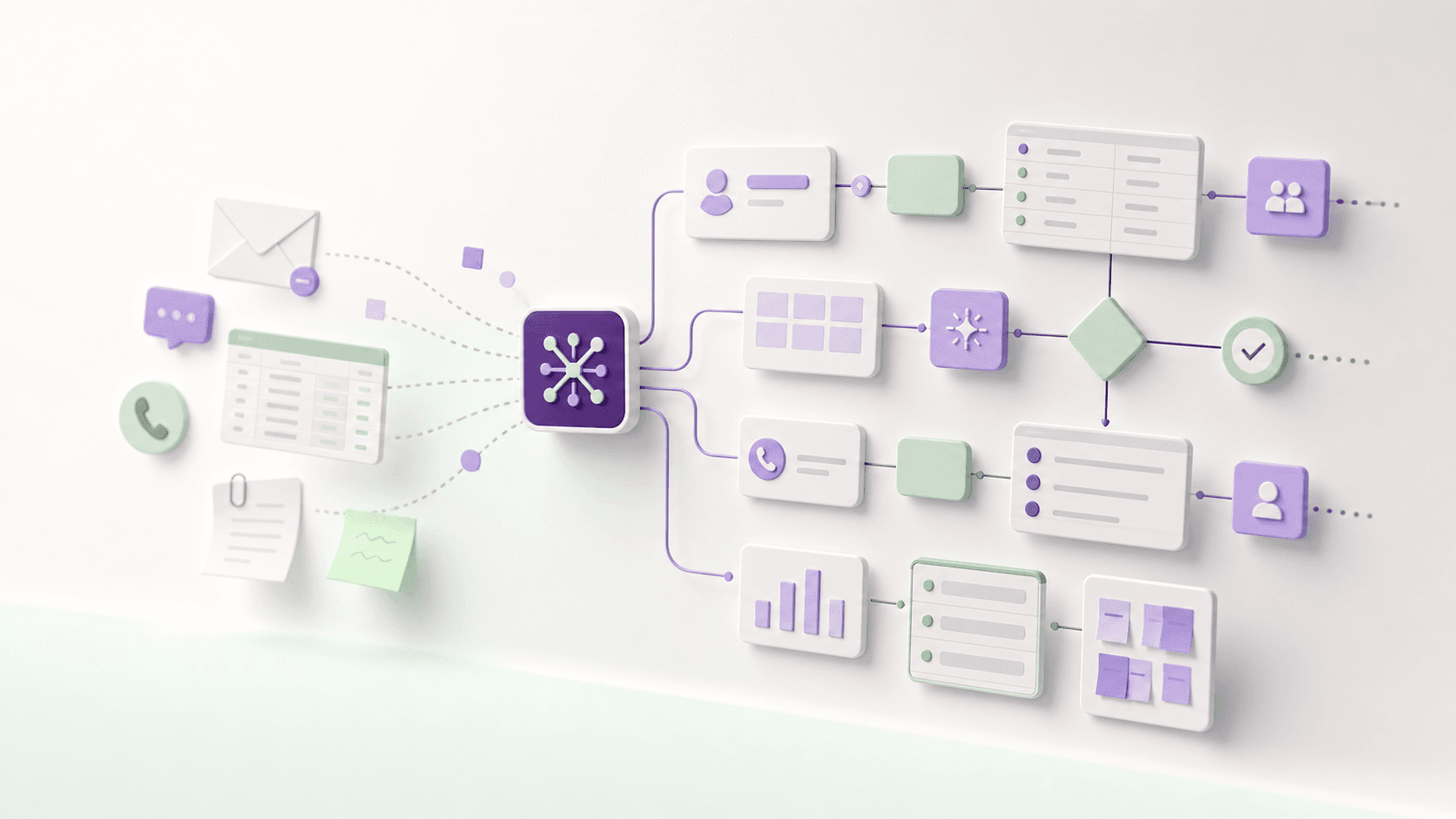
Starts from natural language
The client does not need technical diagrams or complex documentation before the session.
AI Readiness Assessment / Process Intelligence
Understand where to apply AI before implementing it: we turn your process description into an AS-IS map that reveals bottlenecks, manual work and operational priorities.
In a guided session, AI Process Discovery simulates queues, resources and backlog, generates a Human-in-the-Loop TO-BE scenario and closes with three realistic AI priorities for your SME.
Many operational flows live across email, phone calls, spreadsheets, partial ERPs and tacit knowledge held by key people. Before automating, the company needs to see how work really happens.
AI Process Discovery starts from natural language, requires minimal setup and produces a concrete basis for investment decisions: map, bottlenecks, future scenario and implementation next step.
PROBLEMS
When the process is unclear, every AI initiative risks starting from the wrong point.
Processes described verbally, undocumented and dependent on tacit knowledge.
Exceptions, manual steps and hidden bottlenecks that are hard to measure.
Disconnected tools across email, spreadsheets, ERPs, phone calls and portals.
AI investments decided without knowing where operational impact will be highest.
PROCESS
A process-first session that turns operational chaos into map, evidence and decision.
Interview and natural-language process description, including actors, steps, exceptions, volumes and estimated times.
Generation of a readable, validatable map shared between management and operations.
Lightweight analysis of queues, WIP, backlog, resources and saturation to reveal where the flow slows down.
Identification of automations, assistants, orchestrations and human checkpoints connected to real bottlenecks.
Process redesign with AI assist, parallel flows and Human-in-the-Loop governance.
Close with three implementation priorities, potential value and a recommended next step.

DIFFERENTIATORS
The client does not need technical diagrams or complex documentation before the session.
It makes visible flows that currently live across people, disconnected tools and recurring exceptions.
It highlights bottlenecks, queues, manual load and dependencies before selecting technology.
Every AI opportunity comes from an operational friction, not from abstract recommendations.
AI prepares, simulates and proposes; people validate, decide and govern critical steps.
The output becomes the basis for an assessment, pilot project or measurable implementation proposal.
USE CASES
The first ideal vertical is logistics, but the method works across repetitive operational processes with frequent exceptions.
OUTPUTS
Validated AS-IS map
Priority bottlenecks
AI opportunities ordered by impact and feasibility
Human-in-the-Loop TO-BE scenario
Three implementation priorities
Recommended next step
Tell us where your company loses time, clarity, or control. We help you understand whether AI, automation, and custom software can create real value.