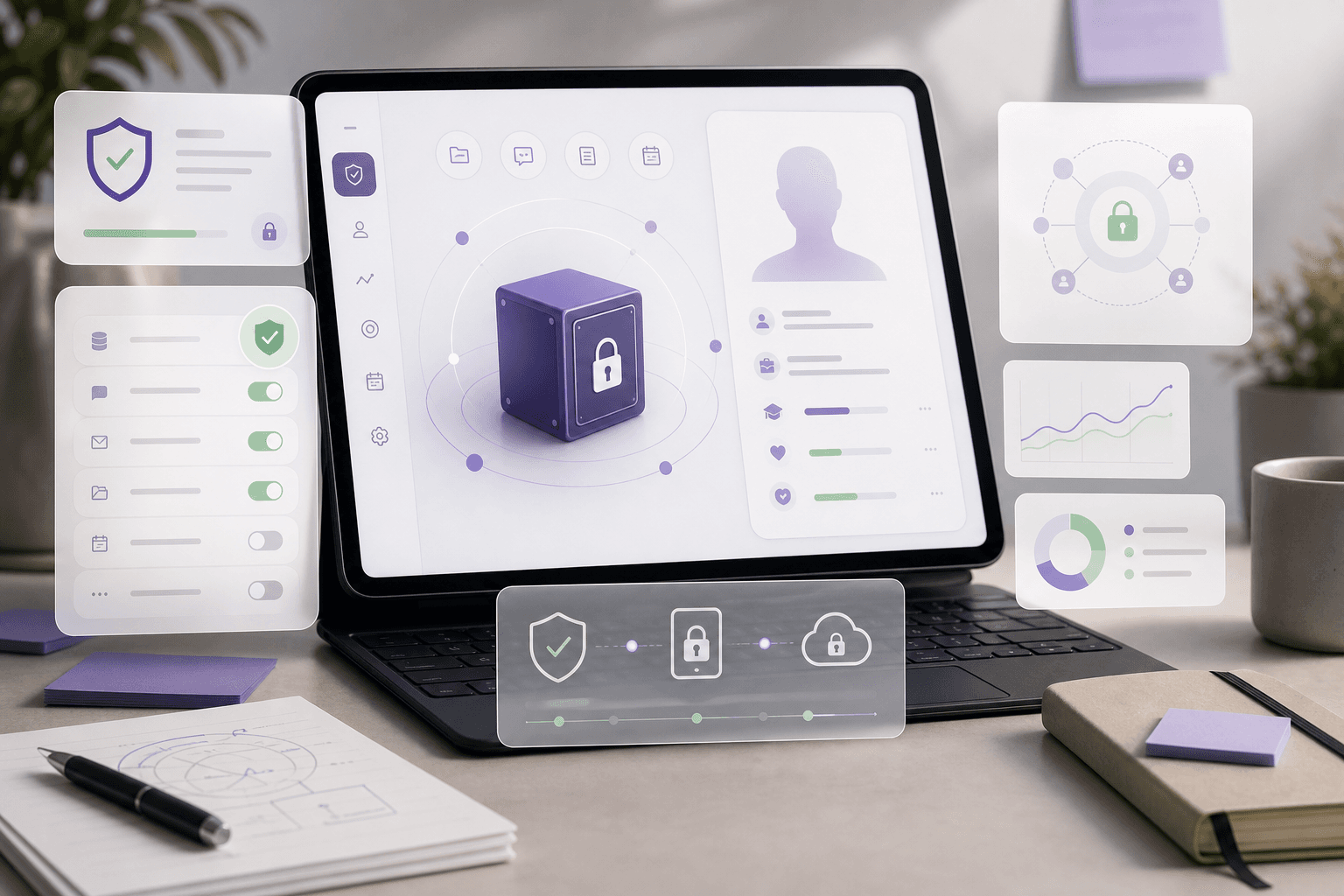
Consent & Boundaries
Consent path, purposes, prohibited uses, limits, export, reset and person-level control.
Privacy-first AI / People Development
A personal, non-diagnostic and correctable digital twin that helps people, coaches and HR teams turn needs, patterns and contexts into concrete support.
Each person completes a guided path: the system generates useful hypotheses, evidence, confidence and a Twin Memory Card to adapt learning, communication and AI assistants.
Digital Twin HR creates a personal layer between the person, HR paths and their own AI copilot: it does not classify, diagnose or decide on people.
The twin produces probabilistic hypotheses with evidence, counter-evidence, context and confidence. The person can correct, reject, export or delete their profile.
PROBLEMS
Assessments, coaching, training and wellbeing often remain separate, static and hard to act on.
HR reports that describe traits but do not suggest micro-actions, tone, boundaries and support modes.
Learning and coaching paths that adapt poorly to energy, context, motivation and stress.
Sensitive personal data handled without enough control, transparency or minimization.
Generic AI assistants that do not know the person's needs, values, patterns and preferences.
PROCESS
A modular path that starts from consent and boundaries, gathers voluntary signals and generates a non-diagnostic operational profile.
Explains purposes, limits, allowed uses, prohibited uses, privacy and the right to edit or delete.
Questionnaires, scenarios, micro-choices, journal and observable feedback are collected only with consent.
The system reads traits, guiding needs, values, strengths, archetypes and systemic loops with evidence and limits.
The person sees useful hypotheses, can edit or reject them and keeps agency over their own twin.
Produces a protocol for AI assistants, coaches or L&D paths: how to communicate, motivate and support.
Journal entries and new evidence improve context and stability without turning the profile into a fixed identity.

CORE MODULES
Consent path, purposes, prohibited uses, limits, export, reset and person-level control.
Maps traits, guiding needs, values and strengths with score, confidence and context of validity.
Narrative patterns in resource and shadow mode, useful for coaching and development conversations.
Triggers, need, action, others' response and micro-interventions to interrupt costly cycles.
A copyable card for a personal AI assistant, covering tone, priorities and support in critical moments.
Rules-only mode, local Ollama or optional WebLLM, avoiding unauthorized transfer of sensitive data.
USE CASES
Start from support for the person, then extend only with consent to coaching, learning and team development.
PILOT METRICS
Scan completion
Perceived usefulness of the report
Number of user corrections
Twin Memory Card usage
Progress on micro-interventions
Coaching and L&D satisfaction
Tell us where your company loses time, clarity, or control. We help you understand whether AI, automation, and custom software can create real value.