Works on real documents
Interprets practice sources and does not generate generic out-of-context answers.
AI Legal Document Automation / NotaryTech
The AI assistant for notary firms that turns practice documents into a pre-filled DOCX deed draft aligned with templates, clauses and the firm's style.
It does not replace the notary: it reduces repetitive work required to reach the first reviewable draft, while responsibility and final control remain with the professional.
Energy certificates, cadastral records, technical reports, deeds of origin, preliminary agreements and personal documents contain data to read, copy and check.
Notaio Assistant creates an intelligent layer between practice documentation and notary software, generating a DOCX draft to review and import into the firm's workflow.
PROBLEMS
The first draft requires a lot of repetitive work before professional review even begins.
Manual reading of energy certificates, cadastral records, technical reports, deeds of origin and preliminary agreements.
Copying data from PDFs, scans, folders, emails and management systems.
Selecting and adapting recurring clauses to the notary's style.
Managing missing, ambiguous or inconsistent data across sources.
SOLUTION
The platform starts from a high-volume deed type and progressively expands to other cases.
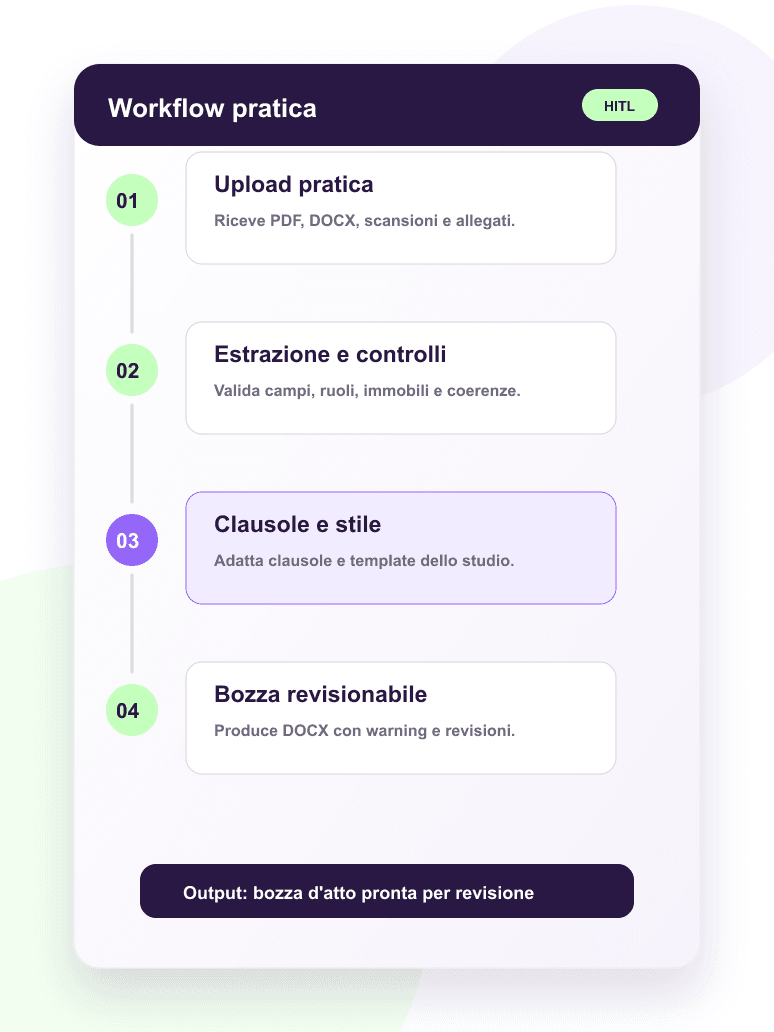
Receives practice documents and recognizes deed type, parties, roles and properties.
Extracts data from PDFs, DOCX and scans, validating required fields and consistency.
Suggests compatible clauses and works on templates, historical deeds and the firm's drafting style.
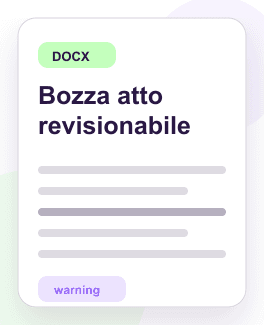
Generates a pre-filled DOCX with fields to check, warnings and feedback loop.
DIFFERENTIATORS
Interprets practice sources and does not generate generic out-of-context answers.
The professional keeps review, responsibility and final control.
Extracts, structures, validates and generates an operational draft.
Adapts templates, clauses, historical deeds and specific drafting style.
Highlights missing, ambiguous or inconsistent data before review.
Uses feedback and corrected deeds to improve quality and consistency over time.
DOCUMENTS AND OUTPUT
The recommended first perimeter is a recurring deed type, such as real-estate purchase.
PILOT METRICS
Average draft preparation time
Fields correct at first pass
Accepted clauses
Corrections per deed
Hours saved per practice
Covered deed types
Tell us where your company loses time, clarity, or control. We help you understand whether AI, automation, and custom software can create real value.